RAG vs. Long Context: The Architecture Debate Every AI Builder Faces
What I learned building retrieval pipelines during my PGPM in Data Science & Finance, and what the 2026 research actually says

Every large language model carries an expiration date baked into it. The moment training ends, its knowledge freezes — it has no idea what happened yesterday, and no idea what's sitting in your company's internal documents. Every serious LLM application has to solve the same problem: how do you get the model to reason over information it was never trained on?
There are two dominant answers to that question, and over the past few months — building retrieval pipelines as part of my PGPM in Data Science & Finance at the Great Lakes Institute of Management, Chennai — I've spent a lot of time in the middle of this exact debate. This post is my attempt to lay out both approaches properly: not just how they work, but what the research actually says about when each one wins, because the honest answer is more nuanced than either camp likes to admit.
The Two Approaches
Retrieval-Augmented Generation (RAG) is the engineering-heavy option. You break your documents into chunks, convert each chunk into a vector using an embedding model, and store those vectors in a vector database. When a user asks a question, the system runs a semantic search, pulls back the most relevant chunks, and feeds only those into the model's context window. The LLM never sees your whole knowledge base — it sees a curated slice of it, assembled fresh for every query.
Long Context is the brute-force option. Instead of building a retrieval layer, you hand the model the raw documents directly and let its attention mechanism do the work of finding what matters. This used to be impractical, but context windows have grown fast: as of mid-2026, Claude sits around 1 million tokens, Gemini 3 Pro is at roughly 2 million, and Llama 4 Scout has pushed past 10 million. That's enough headroom to drop an entire contract, codebase, or research corpus into a single prompt and just ask your question.
On paper, long context looks like it should win by default — why build a whole retrieval pipeline if you can just paste everything in? The research says it's not that simple.
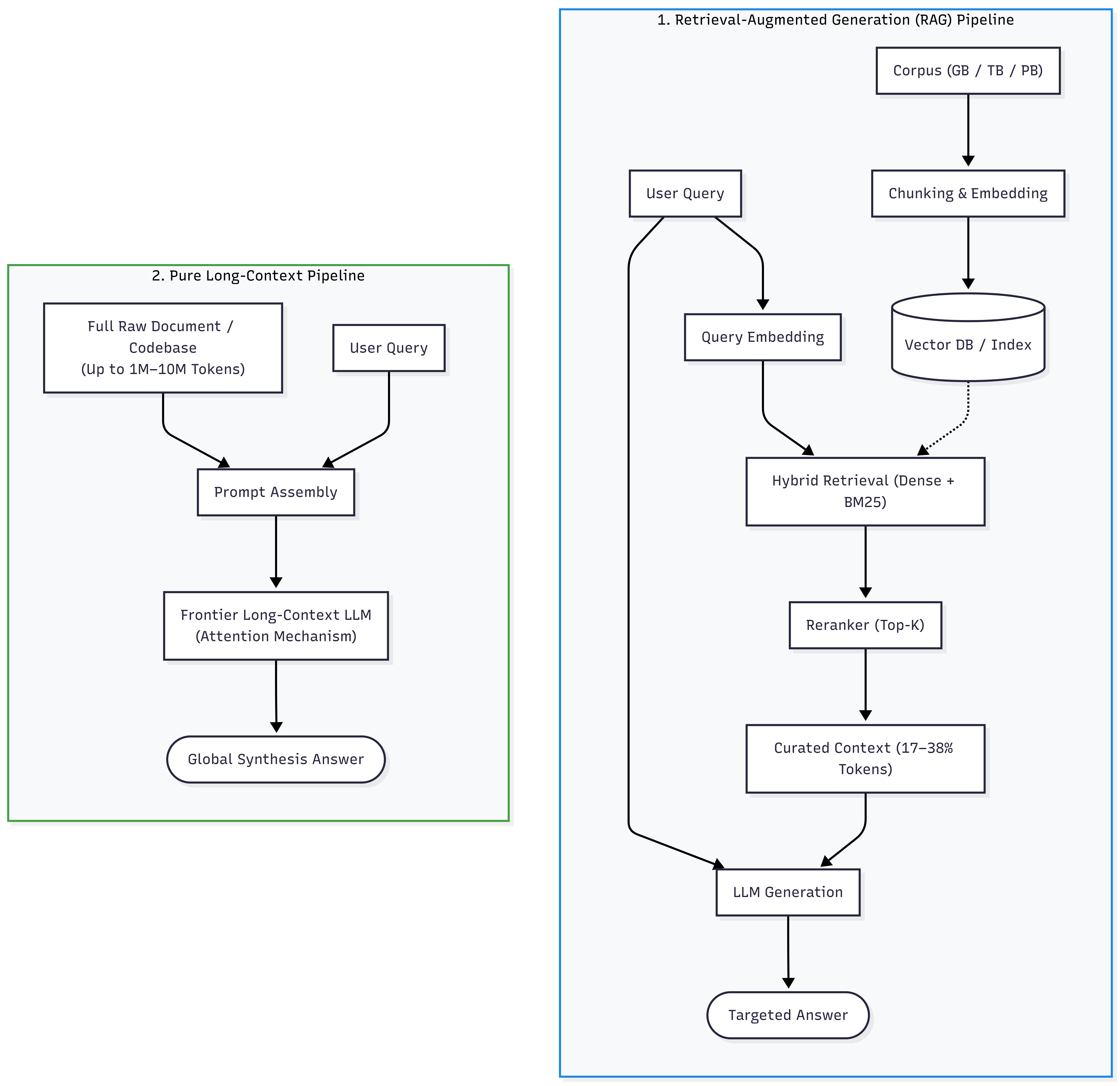 The two pipelines side by side. Notice RAG's retrieval step is itself two-stage — dense vector search combined with BM25 keyword search — before reranking narrows things down to the curated context that actually reaches the model.
The Case for Long Context
The appeal is real, and it comes down to three things:
- It collapses the stack. No chunking strategy to tune, no embedding model to pick, no vector database to run, no reranker to bolt on afterward. Fewer moving parts means fewer places for the system to quietly break.
- It removes the "retrieval lottery." RAG's biggest weakness is that it depends entirely on semantic search finding the right chunk. If the retriever misses, the model never sees the answer — and it fails silently, often producing a confident, wrong response rather than an obvious error. Long context sidesteps this because there's no retrieval step to fail.
- It handles "whole book" reasoning. RAG hands the model isolated snapshots, which makes it weak at questions that require comparing or synthesizing across an entire document set. Long context lets the model hold everything in view at once — genuinely useful for tasks like reviewing a single contract end-to-end.
The Case That RAG Still Matters
But three well-documented problems keep pulling builders back to retrieval, and this is where the 2026 research got a lot more concrete than I expected going in.
Cost is the biggest one, and it's not close. One widely cited comparison from Elasticsearch Labs found RAG achieving roughly 1,250x lower cost per query than a pure long-context approach. Separately, researchers comparing token usage found that RAG systems typically process only 17–38% of the tokens that long-context approaches require for the same task — because long context re-processes the entire document on every single query, while RAG does the expensive indexing work once and then retrieves cheaply forever after.
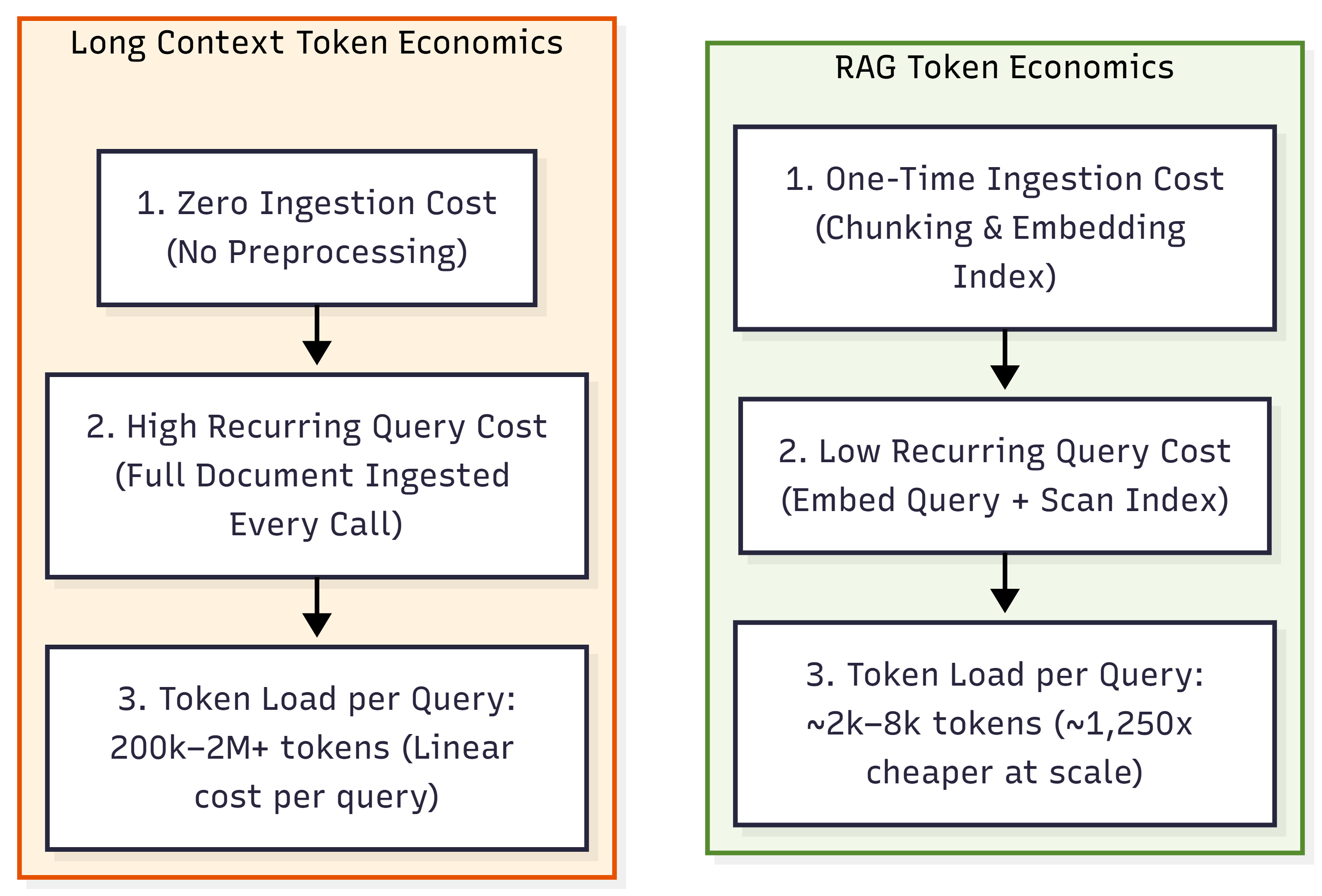 The economics in one picture: long context trades a cheap setup for an expensive, linearly-scaling per-query bill; RAG front-loads the cost once and stays cheap on every call after that.
"Lost in the Middle" is real, and bigger windows don't fix it. This is the finding that surprised me most. Stanford researchers documented that transformer models attend most strongly to information at the very beginning and end of a context window, and accuracy drops sharply — by 30% or more in some evaluations — when the relevant fact sits buried in the middle. Growing the context window from 1 million to 10 million tokens doesn't solve this; it just makes the "middle" bigger. RAG sidesteps the problem entirely by never putting irrelevant material in front of the model in the first place.
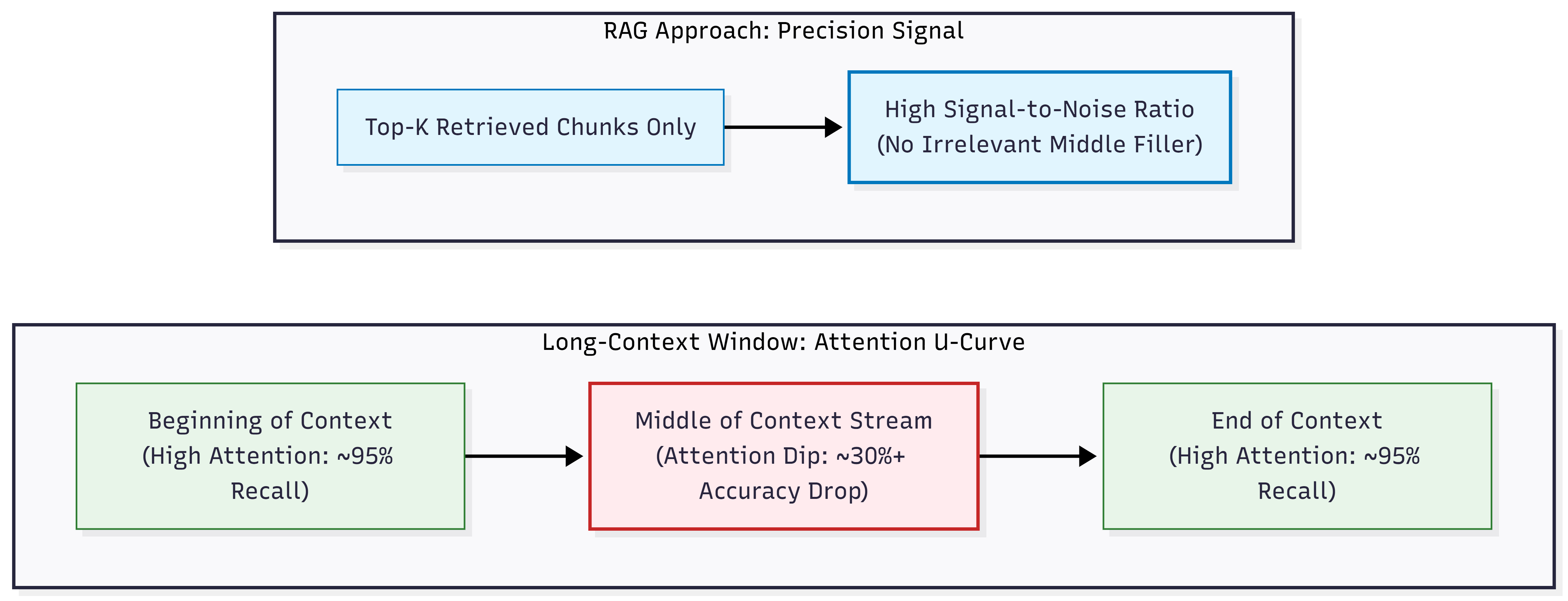 RAG's advantage isn't just retrieval accuracy — it's that there's no "middle" for the model to lose things in. Long context's attention follows a U-curve: strong at both ends, weak in between.
Enterprise data simply doesn't fit. No context window, however large, holds a genuine enterprise data lake measured in terabytes or petabytes. At that scale a retrieval layer isn't an optimization — it's the only way to get from "everything we know" down to "what's relevant to this query."
Neither Side Wins Outright — the Research Backs a Router
The most useful academic framing I found treats this less as "RAG vs. long context" and more as "which one, when." A 2025 analysis found that the conflicting results in earlier papers largely came down to model capacity: weaker open-source models benefit heavily from retrieval because they struggle to use long context well, while strong closed-source models with genuinely strong long-context ability often perform better with full documents in front of them. In other words, some of the "RAG vs. long context" debate was really a "weak model vs. strong model" debate in disguise.
This is why the SELF-ROUTE framework, proposed in one of the more influential papers on the topic, doesn't pick a side at all — it lets the model decide, on a per-query basis, whether a question needs the full long-context treatment or can be answered from retrieved chunks, specifically to keep costs down without giving up accuracy on the queries that genuinely need global reasoning.
In practice, the more advanced version of this idea goes a step further than a two-way RAG/long-context split. A query classifier and router sits in front of everything, and routes each incoming query down one of three paths — retrieval for pinpoint, cost-sensitive lookups, long context for whole-document reasoning, and GraphRAG for multi-hop, relational questions that neither flat retrieval nor a single context window handles well:
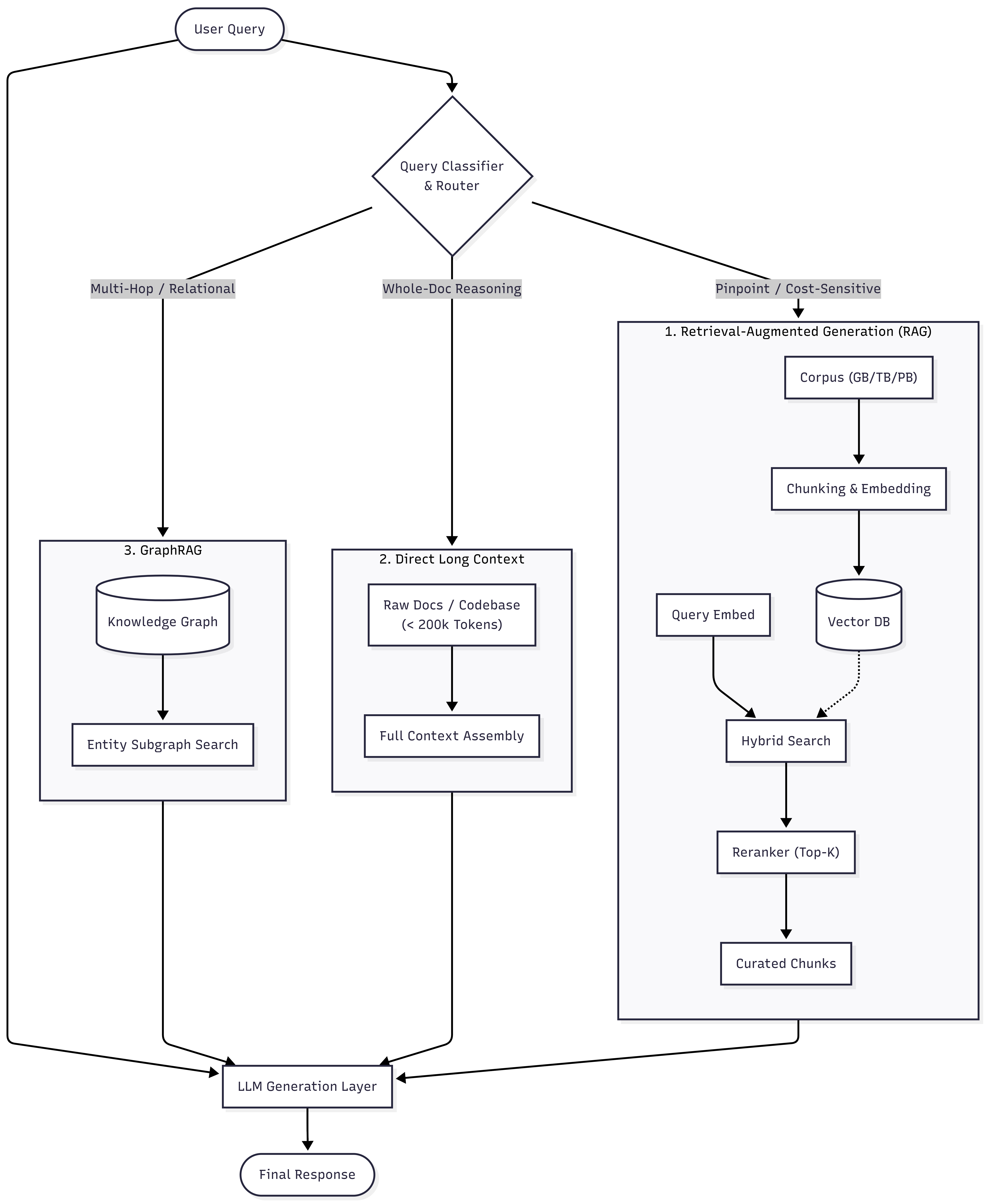 A three-way hybrid router. Each path is optimized for a different query shape, and all three converge on the same generation layer before producing a final response.
Here's the same architecture as a runtime sequence — what actually happens, message by message, for each of the three routes:
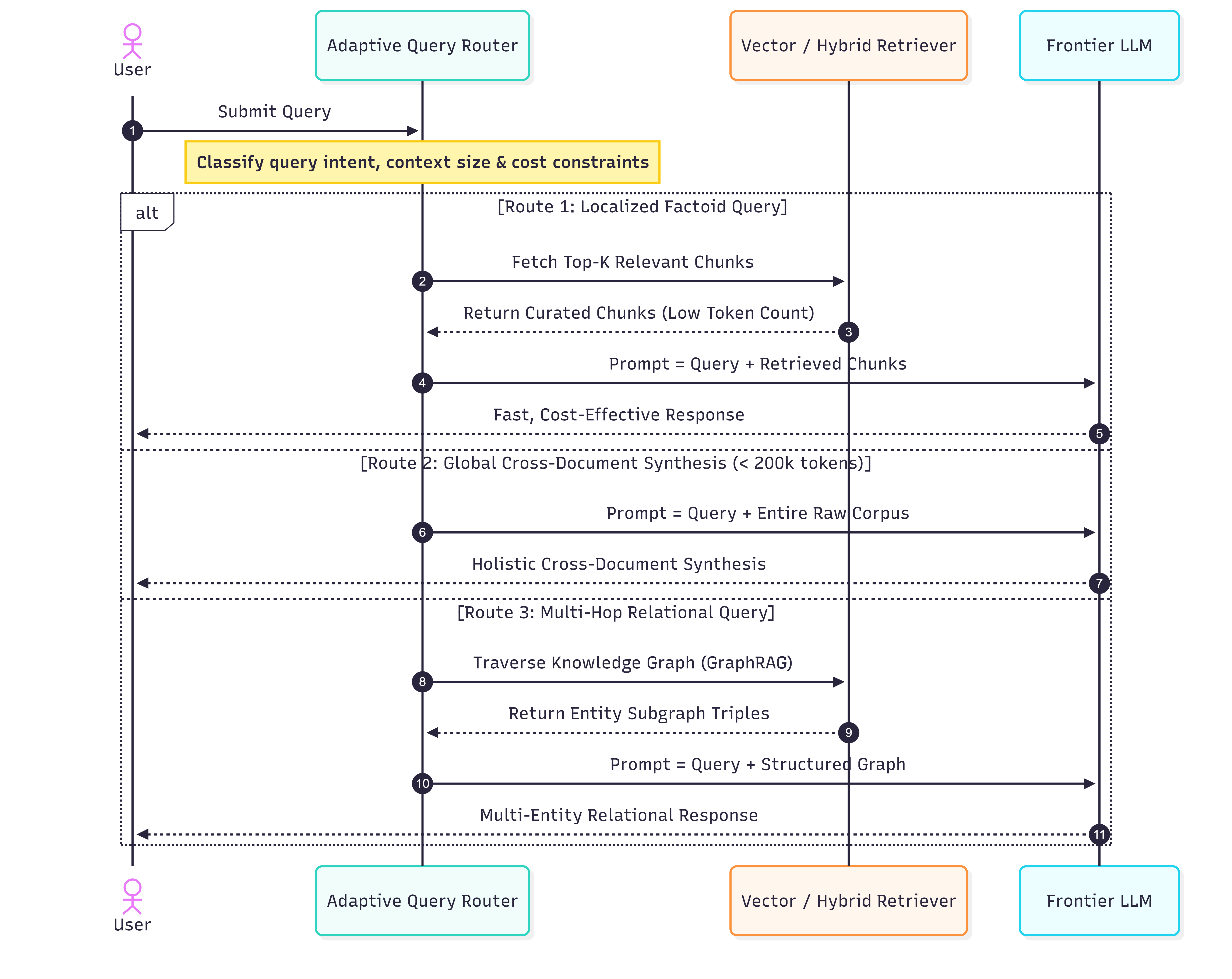 Route 1 fetches curated chunks for a fast, cheap response. Route 2 skips retrieval entirely and hands the model the whole corpus for holistic synthesis. Route 3 traverses a knowledge graph for relational, multi-hop questions.
And the market seems to be arriving at the same conclusion the researchers did. VentureBeat's enterprise survey data showed intent to adopt hybrid retrieval architectures tripling from about 10% to 33% in a single quarter in early 2026, even as a notable share of enterprises still had no production RAG system running at all. Interest in pure long-context-as-the-whole-architecture spiked briefly on the back of big model announcements, then largely faded as teams ran into the cost and "lost in the middle" issues in practice.
A Practical Framework
Pulling this together, here's the decision framework I've settled on for my own projects:
| If your situation is... | Lean toward... |
|---|---|
| A bounded dataset (a single contract, a report, a codebase under ~200K tokens) that needs global, cross-document reasoning | Long context |
| A large or fast-changing knowledge base queried at high volume | RAG |
| Cost-sensitive production system with frequent queries | RAG |
| You're using a smaller or open-source model | RAG (it needs the help finding the signal) |
| You're using a frontier model and the corpus is small enough to fit comfortably | Long context, since it removes the retrieval-failure risk |
| You genuinely don't know in advance | Hybrid / adaptive routing — let the system pick per query |
As a decision tree, the same logic looks like this — starting from knowledge base scale and query volume, then narrowing down through model class and reasoning requirements:
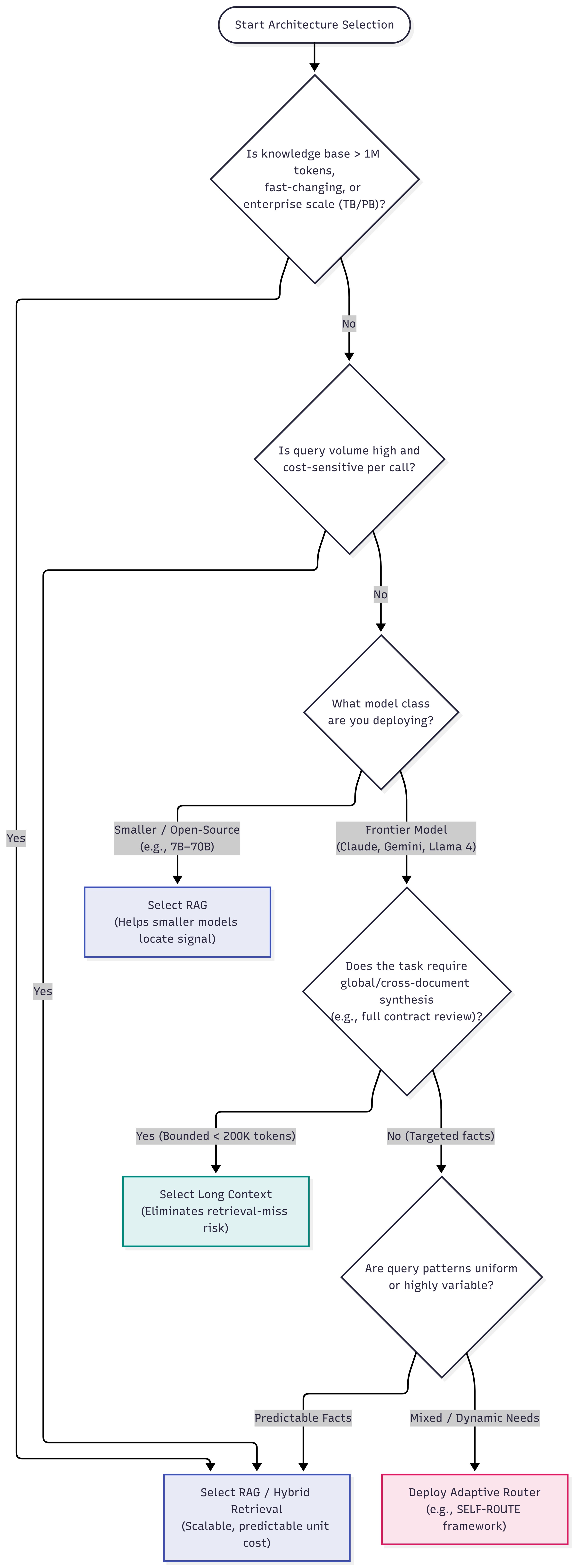 Enterprise scale or high query volume routes straight to RAG. Bounded corpora on frontier models route to long context. Everything with mixed or unpredictable query patterns routes to an adaptive router.
That last row is where the field is clearly heading. Rather than treating this as an either/or architectural bet made once at design time, the more sophisticated systems I read about — Agentic RAG, GraphRAG, adaptive routers — treat retrieval as one tool among several that the system can choose to invoke or skip depending on the query. Advanced RAG with hybrid dense-plus-keyword retrieval and a reranker is emerging as the sensible production default, with agentic, graph-based, or long-context escalation reserved for the queries that actually need it.
Closing Thoughts
Coming into this topic through coursework and hands-on projects, my instinct was that bigger context windows would simply make RAG obsolete over time. The research doesn't support that. Long context and RAG aren't competing replacements for each other — they're solving different parts of the same problem: long context is about depth of reasoning over a bounded set of material, while RAG is about filtering scale down to something a model can actually reason over affordably. The systems that are winning in production right now aren't the ones that picked a side — they're the ones that built both capabilities and let the query decide which one to use.
Further Reading
- Li, Z. et al. — "Long Context vs. RAG for LLMs: An Evaluation and Revisits" (arXiv 2501.01880)
- Liu, N. F. et al. — "Lost in the Middle: How Language Models Use Long Contexts"
- VentureBeat — "The Retrieval Rebuild: Why Hybrid Retrieval Intent Tripled" (April 2026)
- "Beyond RAG vs. Long-Context: Learning Distraction-Aware Retrieval for Efficient Knowledge Grounding" (arXiv 2509.21865)
- "20 Advanced RAG Types to Know in 2026", Turing Post