I’m Trying to Turn Around My Uncle’s Hotel — and It Became a Data Project
What began as helping at a struggling hotel in Guwahati turned into a self-directed experiment in operations, marketing, software, and travel.

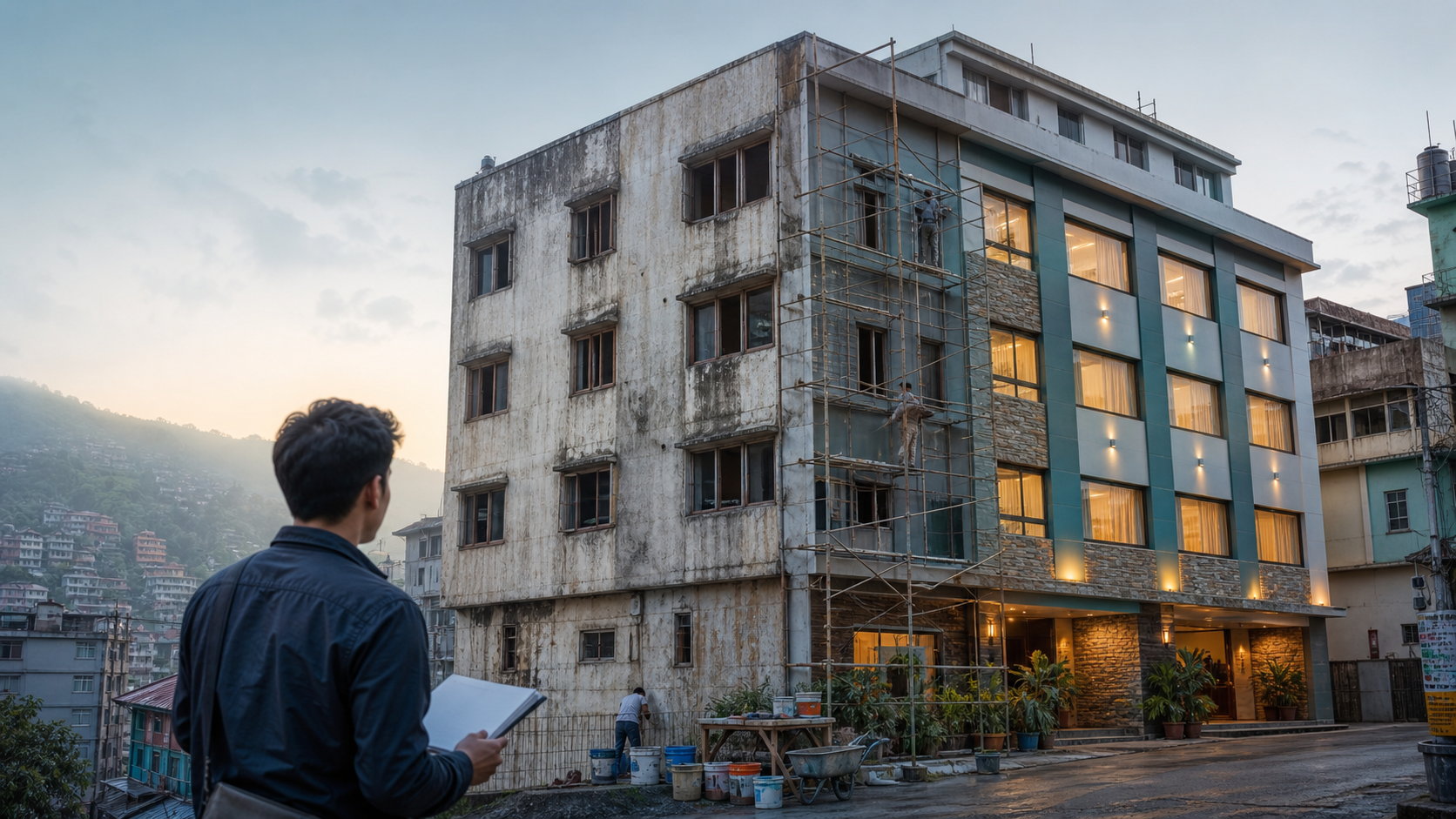
Editorial illustration created for this post. It does not depict either real property.
This is not a hotel success story. At least, not yet.
It is a project I am working on at my uncle’s hotels in Guwahati, with his permission. I am not the owner, and I am not trying to present myself as a veteran hotelier. I am treating the work as a self-directed project: part operations, part marketing, part software, and part attempt to understand how a struggling local business can rebuild trust.
I began with a fairly simple question:
If a hotel has genuinely improved, but the internet still remembers the old version of it, how do you convince people to give it another chance?
The further I went, the less this looked like a marketing problem. It became a data problem, a software problem, an operations problem, and eventually a much larger hospitality experiment.
The story starts with one rented floor
My uncle started with a mid-range budget hotel near a major railway hub in Guwahati. I will call it the first hotel in this post. The positioning was straightforward: a convenient location, affordable pricing, and practical accommodation for people passing through the city.
The business did not begin by taking over an entire building. It started with the fifth floor on rent.
As operations grew, the first hotel gradually expanded into the floors below. Today, it occupies every floor except the ground floor. I like this part of the story because it says something about how many small businesses actually grow. There was no dramatic launch or massive upfront expansion. It was one floor, then another, with each step supported by what the team had learned from running the previous one.
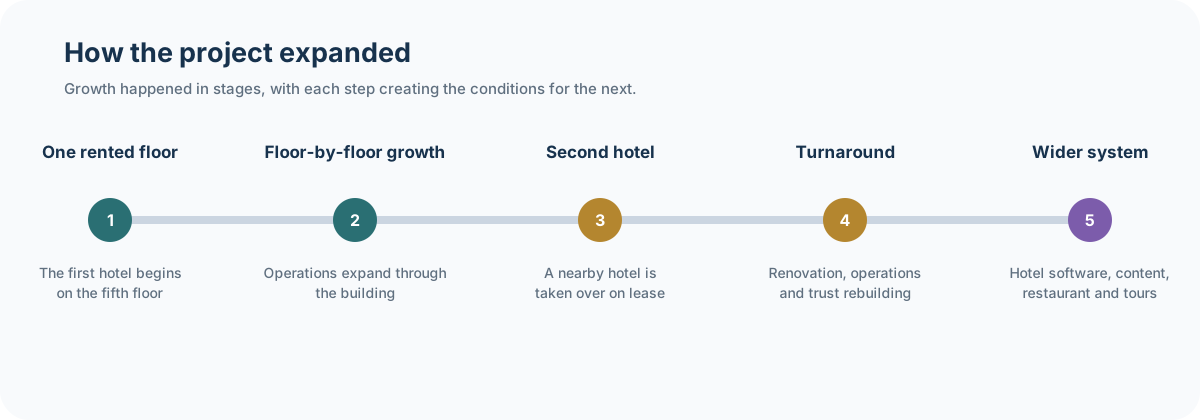
The project grew in stages: one floor, a full hotel operation, a second property, and now a broader system around hospitality.
That experience became the base for the next, much more difficult project.
Taking over a hotel with someone else’s reputation
Around three months ago, my uncle took over the operations of a nearby property on lease. I will call it the turnaround hotel.
The hotel was in poor condition. Maintenance had been neglected, management had failed, and the damage was visible both inside the property and across digital platforms. When I began documenting the project, its public listing carried a weak rating shaped by several hundred historical reviews. I am intentionally keeping the exact figure private because the purpose of this post is to explain the project, not identify the property.
That review history matters. A customer searching for a hotel does not first see the renovated room, the repaired bathroom, or a staff member trying to improve service. They see the name, the rating, the photographs, and years of accumulated opinions.
The obvious escape would have been to change the hotel’s name and start again. But that is not available to us. The property is on lease, and we do not own the naming rights.
So the challenge is unusually clear:
We cannot erase the old reputation. We have to change what the same name means.
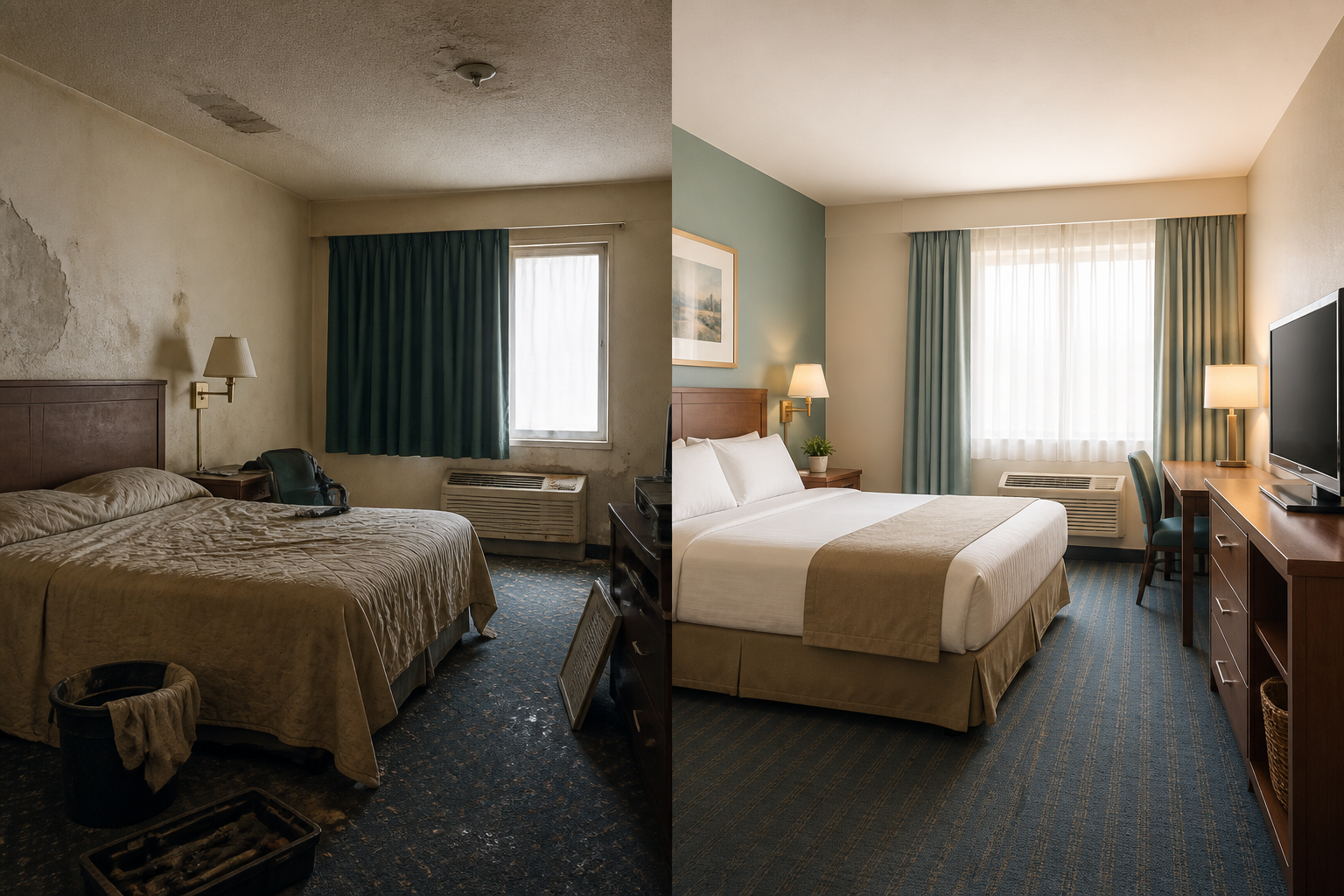
Concept illustration, not a photograph of the hotel. It represents the type of maintenance and room-restoration work involved.
My first instinct was marketing
My initial thought was that marketing could tell people the hotel was under new management.
We had started renovating. We were trying to improve maintenance, rooms, service, and the general experience. But unless people could see that change, the market would continue judging the hotel through old reviews and old photographs.
That is why we started social-media channels. The immediate plan is to document the property honestly: the rooms, the staff, the improvements, the food, the location, and the work still in progress. Paid promotion can come later, once the profile and booking journey are ready to convert attention into actual enquiries.
But I quickly realized something uncomfortable: marketing a hotel before the experience is ready can make the problem worse. Advertising does not repair trust. It only brings more people into contact with whatever reality currently exists.
The sequence has to be:
- Fix what the guest experiences.
- Show credible evidence of the improvement.
- Make it easy to enquire or book.
- Track what happens next.
- Use the evidence to decide what to improve again.
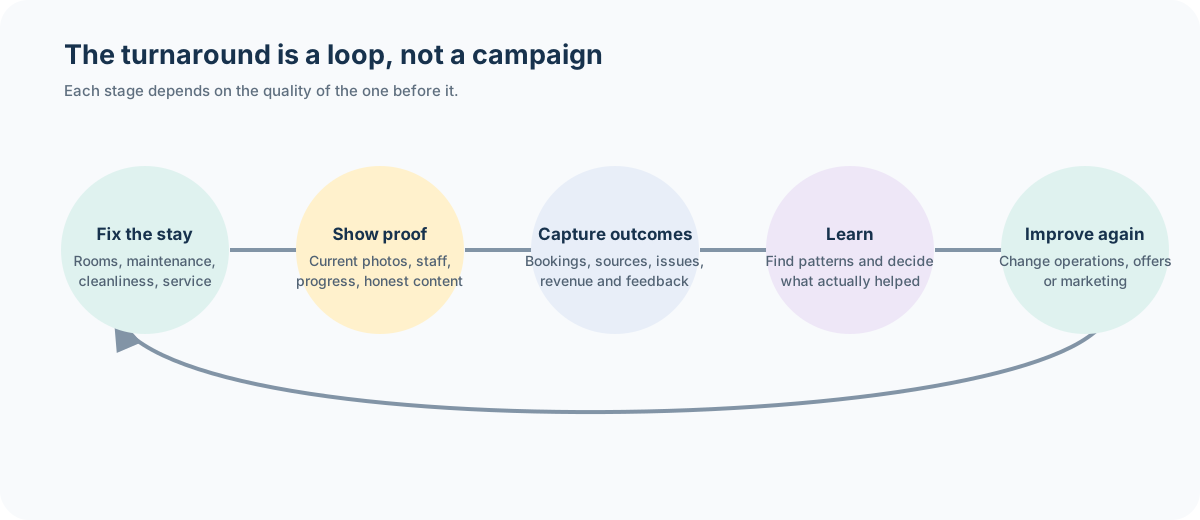
Marketing is only one stage of the loop. If operations do not improve, the loop breaks immediately.
The inherited-rating problem
A rating built from several hundred reviews is slow to move. Even if the next group of guests has a much better experience, the headline average still carries the weight of the past.
That changed how I thought about the Google Business Profile. The goal cannot simply be “get the rating up.” The profile needs to become more current and more useful:
- accurate contact information and booking links;
- current photographs instead of outdated ones;
- professional responses to reviews;
- a steady flow of genuine new feedback;
- visible evidence that recurring complaints are being fixed; and
- proper tracking of calls, website visits, directions, and bookings.
The rating is a lagging indicator. The more immediate signals are recent guest sentiment, fewer repeated complaints, faster responses, and whether people who discover the hotel actually contact or book it.
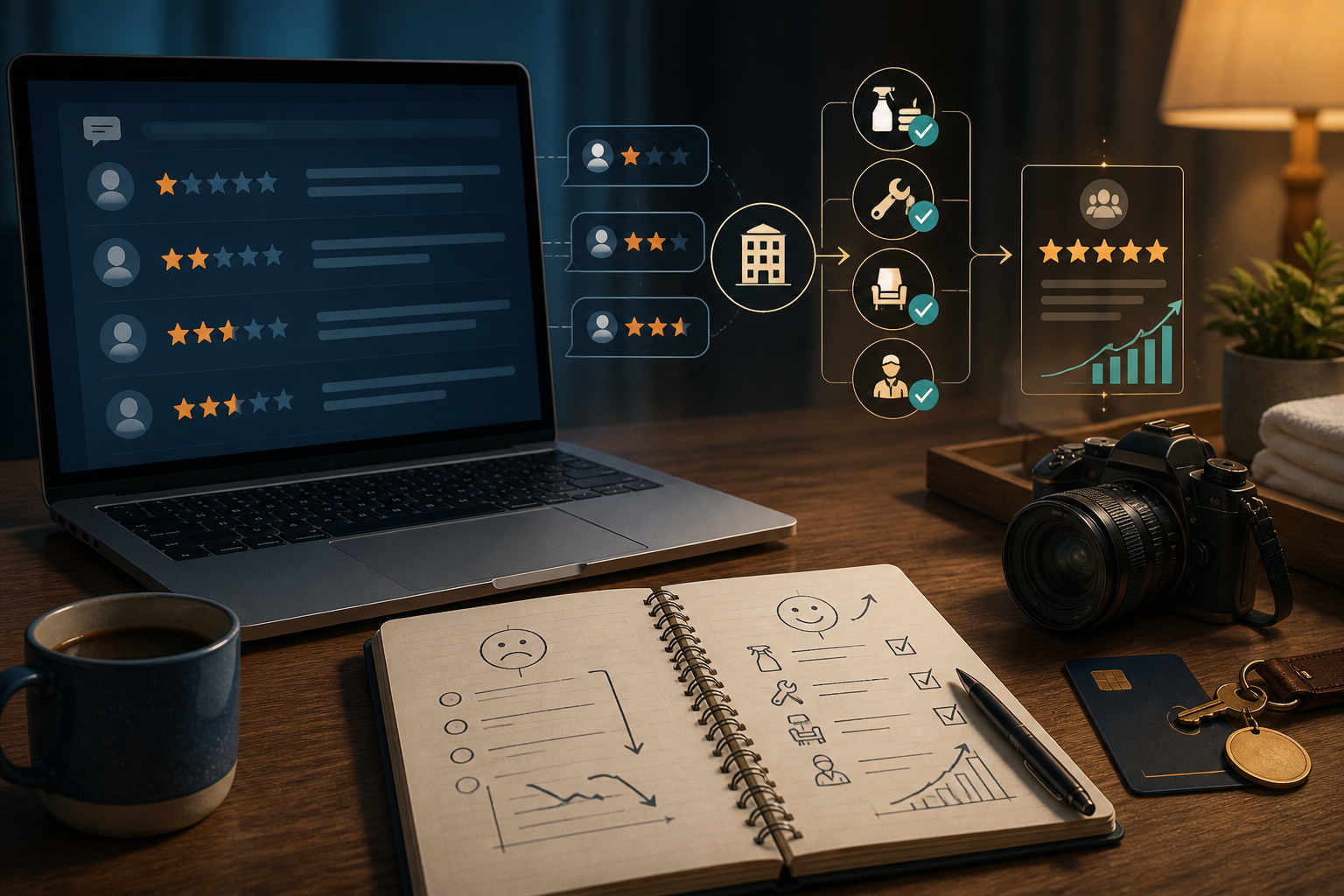
Editorial illustration. The interface and ratings are fictional and do not reproduce the real hotel listing.
Then marketing turned into a measurement problem
Once we began thinking about social media, Google, and paid campaigns, the next question was obvious:
How will we know whether any of this is helping?
Hotels produce a surprising amount of data. Where did the guest discover us? What rate was quoted? Which room did they choose? Did they cancel? Did they order food? Was there a complaint? How quickly was it resolved? Did they return? Did they leave a review?
In theory, our existing hotel software should answer these questions.
In practice, it is a legacy system, and the front desk does not enter data consistently. A dashboard can look very precise while being built on incomplete inputs. If the booking source is missing, “direct bookings from Instagram” cannot be measured. If discounts are entered inconsistently, the average rate becomes unreliable. If complaints live only in WhatsApp messages or someone’s memory, there is no pattern to analyze.
That was the point where I stopped seeing this as only a hotel-marketing project.
Why I started building a hotel web app
I decided to start building our own web application.
The ambition is not to replace every hotel system on day one. The first objective is much simpler: make the important workflows easier to follow and make the resulting data trustworthy enough to manage the business.
For example, every reservation should have a source such as Google, Instagram, the website, an online travel agency, a walk-in, a phone call, or a referral. Room status should reflect what is actually happening. Maintenance issues should have an owner and a resolution time. Management should be able to see a small set of useful daily and weekly numbers without manually rebuilding them from notebooks and messages.
The difficult part is not the dashboard. It is the behaviour underneath it.
If the front desk finds the application slow or confusing, the data will still be skipped. If management does not define which fields are mandatory, a newer interface will reproduce the same old problem. The product has to fit the work, and the work has to become disciplined enough to produce useful data.
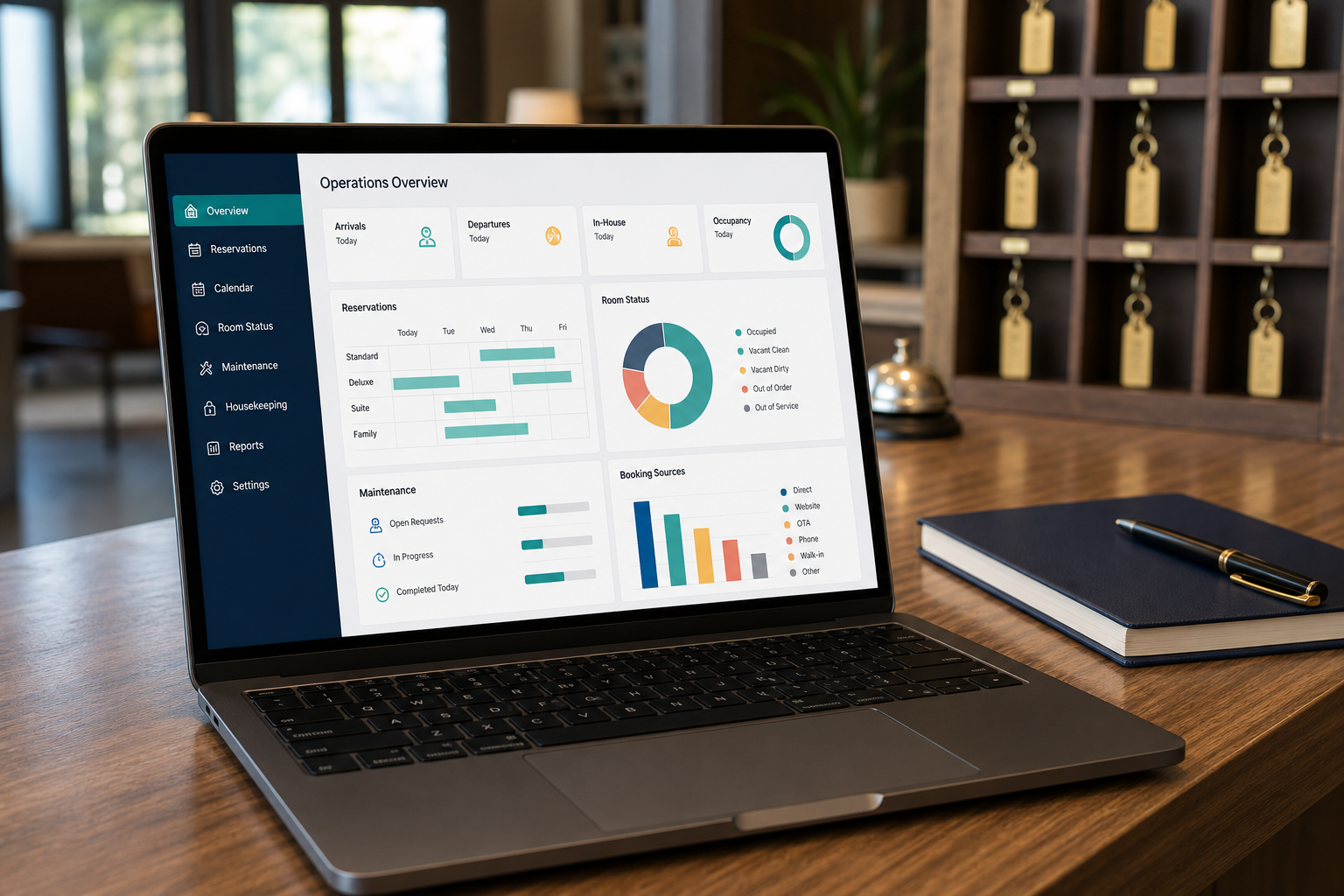
Concept illustration of the product direction. It is not a screenshot of the live application and contains no guest data.
Connecting social media, Google, the website, and the front desk
The website is already prepared and ready to be integrated with the software. In my head, the system should eventually work like this:
- Social media creates awareness and shows the new management’s work.
- Travel content gives people a reason to follow even when they are not actively searching for a room.
- Google captures high-intent local searches.
- The website provides accurate information and a direct path to enquire or book.
- The hotel application records where the customer came from and what happened after the booking.
- Reviews and repeat behaviour tell us whether the actual stay justified the marketing promise.
Without that final connection, marketing becomes a collection of impressions and follower counts. With it, we can begin asking better questions: Which channel brings profitable bookings? Which offer only attracts discount-seekers? Which complaints keep repeating? Which improvements actually change guest feedback?
Why tours entered the picture
Operating two nearby hotels gives us something a new travel business normally has to spend heavily to acquire: a regular inflow of travellers.
Many guests need more than a room. They need airport or station assistance, local transport, a Guwahati itinerary, a Northeast package, or help planning a longer trip. That makes tour operations a logical adjacent service.
The first version does not need to be a giant travel platform. It can begin with a small number of reliable packages, known vendors, clear pricing, and an assisted itinerary process. The front desk can identify interest, but the booking should still pass through a controlled feasibility and confirmation process.
The larger idea is content-led demand.
Pure hotel promotion has a limited audience. Most people do not follow a budget hotel because they enjoy looking at room photographs every week. But they may follow useful stories about Guwahati, Kaziranga, Meghalaya, Dzükou Valley, food, routes, weather, or how to plan a Northeast trip.
Travel content can attract people earlier. The hotel becomes the base, not the entire story.
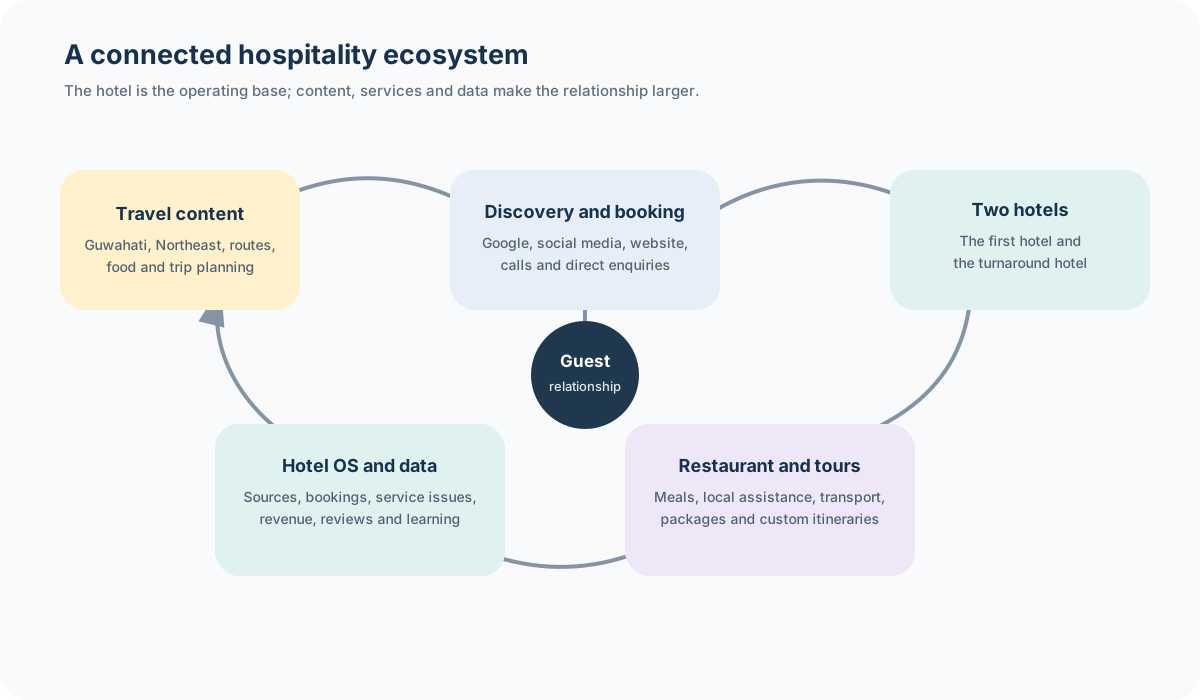
The long-term idea is an ecosystem: content attracts travellers, the hotels host them, tours and food increase the value of the relationship, and data improves the next decision.
The restaurant problem is different
The restaurant has good fundamentals: food quality, taste, service, quantity, and price. What it does not have is the aesthetic interior that performs naturally on Instagram.
After spending on the hotel renovation, there is not much capital left for a complete restaurant makeover. So the promotion strategy has to be honest about what the restaurant is good at.
Instead of trying to look like a fashionable cafe, we can focus on the food itself: close-up dishes, generous portions, value combinations, local options, staff stories, room-plus-meal packages, group menus, and the convenience of eating well without leaving the hotel.
Some visual improvements are still possible without a full redesign: deep cleaning, decluttering, consistent table settings, better lighting in one or two shooting areas, disciplined plating, and a cleaner menu presentation.
The positioning I am considering is simple: good food, fair prices, generous quantity, and dependable service.
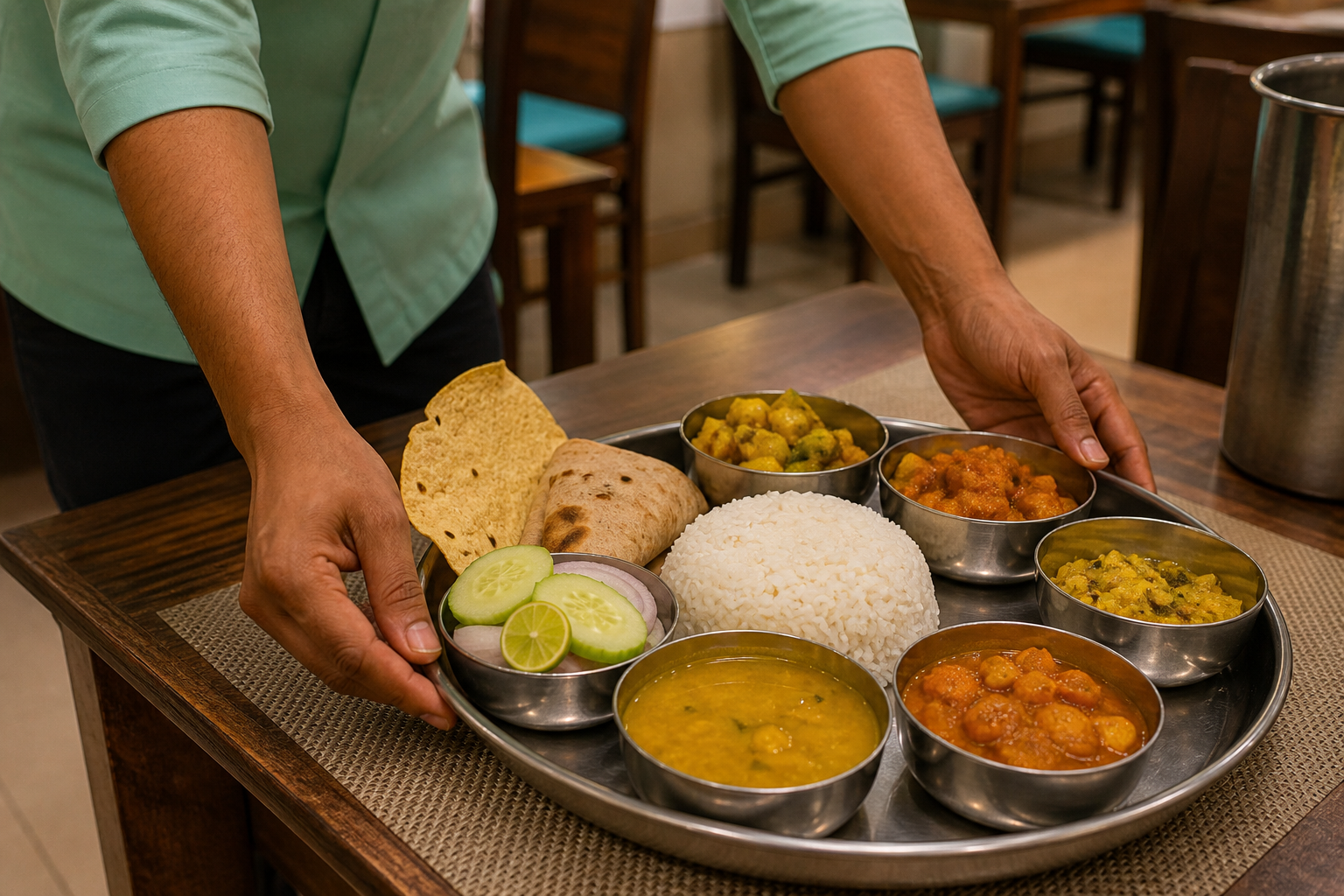
Editorial food image created for this post. It is illustrative and is not presented as an actual menu item or restaurant photograph.
What I am actually trying to learn
This project has become a practical test of several ideas I have mostly encountered separately:
- Can honest, evidence-led marketing help a damaged local brand earn another look?
- Can better software change staff behaviour, or does behaviour have to change first?
- Can two small hotels create enough shared demand and data to support restaurant and tour businesses around them?
- Can travel content attract customers more effectively than direct hotel promotion?
- Can a real operating hotel become the testing ground for a broader hotel-management product?
I do not have clean answers yet. That is what makes it worth documenting.
What I plan to measure
I am deliberately avoiding a dramatic “before versus after” chart for now because we do not have enough reliable baseline data. Inventing a clean graph would defeat the purpose of building a better measurement system.
The first useful dashboard should probably be boring:
- percentage of bookings with a valid source;
- direct enquiries from Google, Instagram, and the website;
- occupancy and average room rate;
- cancellation and no-show reasons;
- room-readiness and maintenance issues;
- recent review volume and recurring complaint themes;
- restaurant sales by hotel guest versus outside customer; and
- hotel guests who enquire about or purchase a tour.
Once this data is captured consistently, I can start publishing real charts instead of attractive guesses.
This is a work in progress
The hotel is still being renovated. The reputation is still damaged. The social channels are new. The software is still being built. The tour operation is only beginning, and the restaurant still has clear physical constraints.
That is the honest state of the project.
I am writing about it now because finished case studies often hide the messy reasoning that came before the result. At this stage, the interesting part is not whether everything succeeds. It is how one practical problem keeps revealing another layer underneath it.
I started by thinking the hotel needed marketing.
Then I realized the marketing needed measurement.
The measurement needed better software.
The software needed better operating discipline.
And the hotels themselves created opportunities in food, tours, and travel content that I had not initially treated as part of the same system.
The question I am testing now is broader than the one I started with:
Can operational discipline, honest communication, and simple technology help rebuild trust in a tired local hospitality business — and turn it into something larger over time?
I will return to this post as the project develops, ideally with real numbers, real mistakes, and a much clearer answer.
A note on the project and data
This is a personal project conducted at my uncle’s hotels with his permission. It reflects my own observations and working hypotheses, not an official statement on behalf of the properties. I have deliberately omitted the property names, exact rating, exact review count, addresses and other identifying details. The generated images are editorial illustrations rather than documentary photographs. Any future screenshots should exclude guest, employee and commercially sensitive information.