FII Selling, DII Buying: Stop Treating Indian Savers as a Market Safety Net
Domestic institutions can absorb foreign selling. That may steady the market. It does not prove that Indian households are getting a good investment.

Every month, salaries become SIPs, insurance premiums and retirement contributions. On a market screen, that patient household money appears as “DII buying”. The phrase sounds institutional and remote. The money often is not.
This is why the comforting headline (DIIs buy as FIIs sell) needs a harder question behind it: what are domestic institutions buying, at what price, and for whose benefit?
Indian households have no duty to defend an index. Institutions managing their savings have a duty to justify the risk. Domestic ownership can spread the gains of productive businesses more widely. It can also transfer more valuation risk to families whose income, property and employment already depend on the same economy.
1. GDP growth cannot justify any share price
As of 31 August 2026, the Nifty 50 was down 7.8% for the calendar year and 1.4% over twelve months. The broader Nifty 500 was down 1.8% for the year but up 4.4% over twelve months. These are price returns and exclude dividends. NSE Market Pulse
The GDP release of 31 August estimated real growth of 7.8% in April–June 2026 from a year earlier. Nominal GDP grew 10.3%. MoSPI GDP release
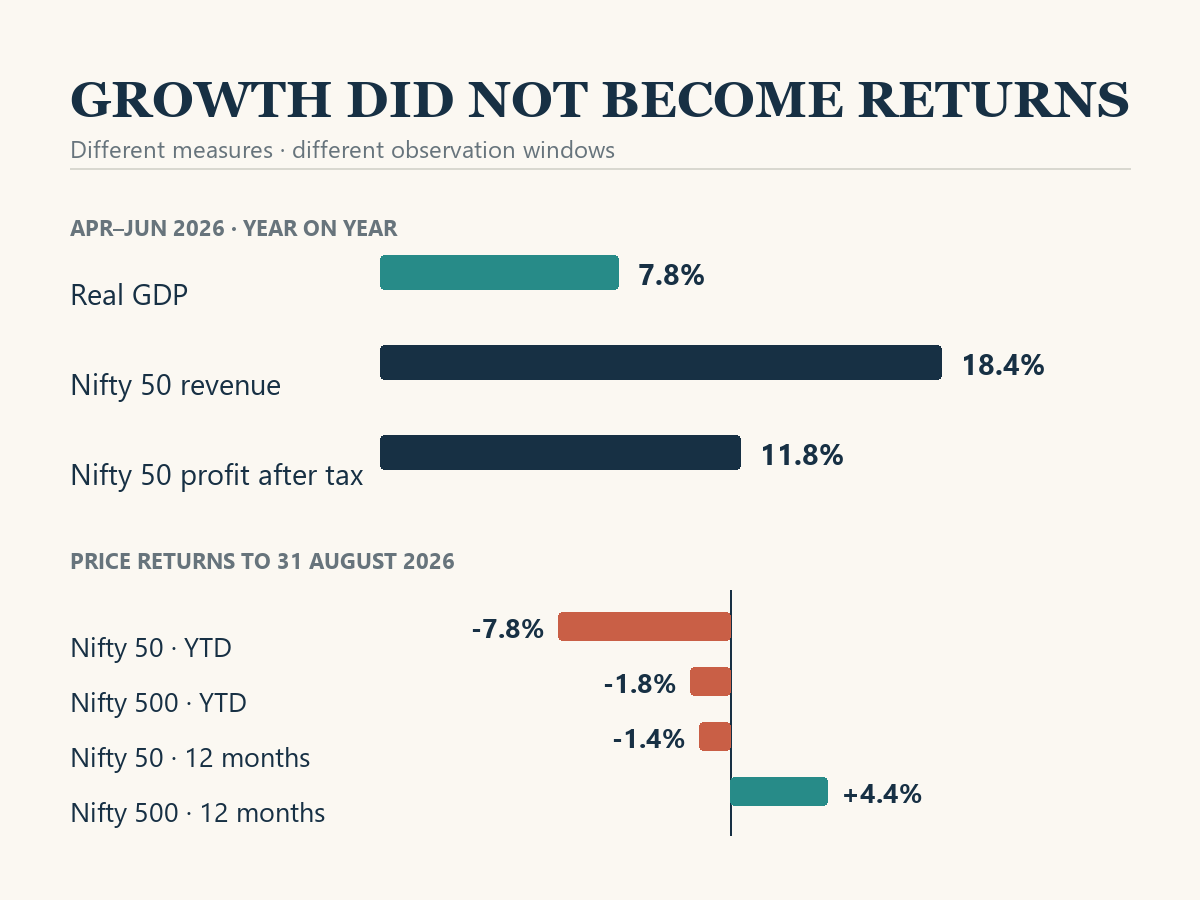
The panels preserve different observation windows. GDP, listed-company earnings and market returns answer different questions. Sources: MoSPI and NSE.
There is no contradiction. GDP measures production across the economy. A share price discounts expected profits of a particular listed company and the valuation investors will pay for them. Growth in construction, public services or unlisted businesses does not flow mechanically into earnings per share.
Corporate results were not uniformly weak. Nifty 50 revenue rose 18.4% and profit after tax rose 11.8% year on year in April–June 2026. Those results still do not establish that the shares were cheap. NSE earnings review
Suppose earnings per share rise from ₹100 to ₹110 while the price-to-earnings ratio falls from 25 to 22. The price moves from ₹2,500 to ₹2,420.
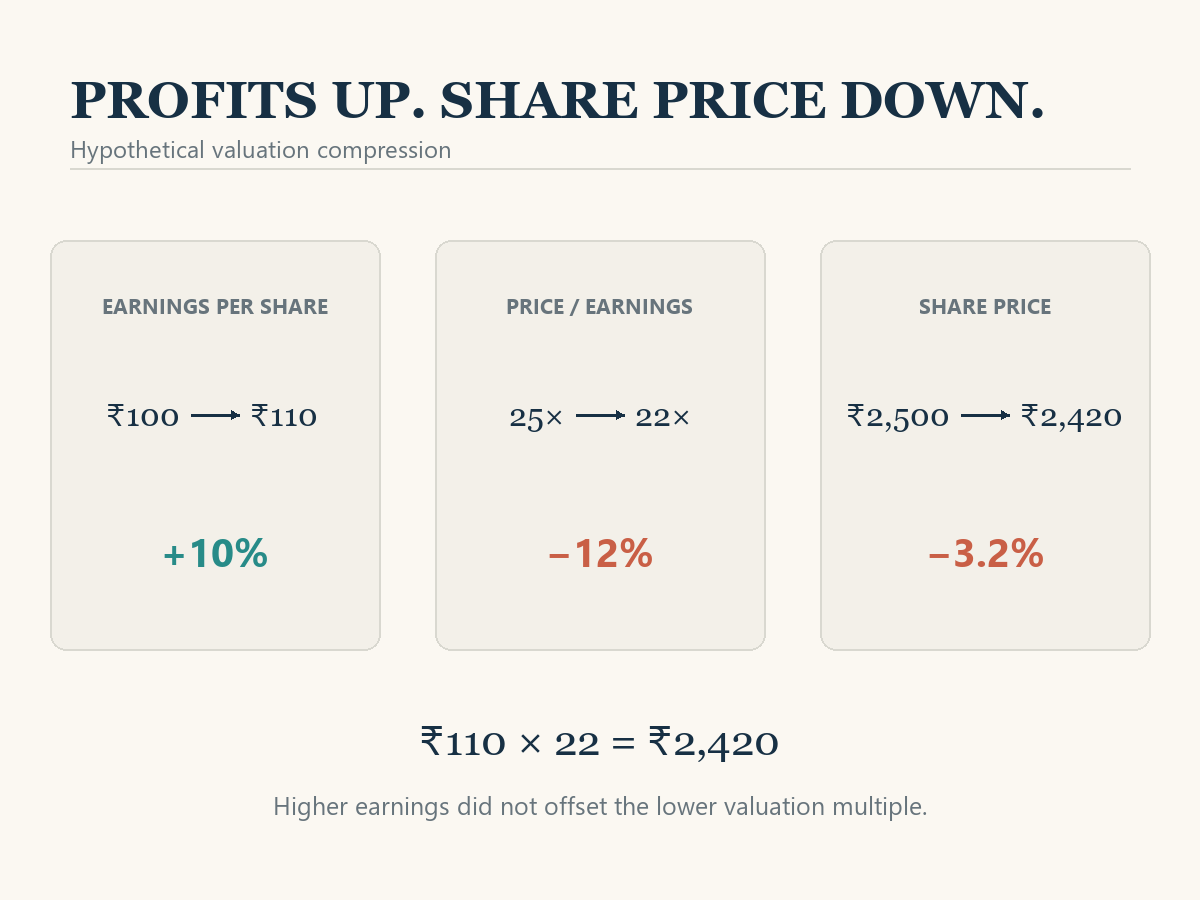
The 3.2% price fall is multiplicative: 1.10 × (22 ÷ 25) − 1. Dividends would contribute separately to total return.
A growing business can be a losing investment when the starting price is too high. This is the error in using GDP as a blanket defence of market valuations. India may grow strongly and investors may still earn disappointing returns. Long-run cross-country research also cautions against treating national GDP growth as a shortcut to equity returns. Ritter, 2005
2. Foreign investors do not owe India permanent capital
“FII” remains the familiar market term; regulatory reporting generally uses “FPI”, or foreign portfolio investor. These investors compare India with equities, bonds and currencies across the world.
Their decisions reflect relative valuations, expected earnings, interest rates, exchange rates, geopolitical risk and redemptions from their own clients. NSE’s ownership analysis discusses pressures including expensive valuations, rupee weakness, US yields and geopolitical uncertainty. Aggregate flows cannot identify the motive behind every trade. NSE ownership study
Currency matters. If $100 enters at ₹85 to the dollar, an 8% rupee gain turns ₹8,500 into ₹9,180. If the exchange rate then moves to ₹90, the investment is worth only $102 before costs, taxes or hedging. A healthy rupee return can become a mediocre dollar return.
We should stop treating portfolio flows as a referendum on patriotism. Foreign investors can underestimate India; domestic investors can overpay for it. Nationality is not an investment thesis.
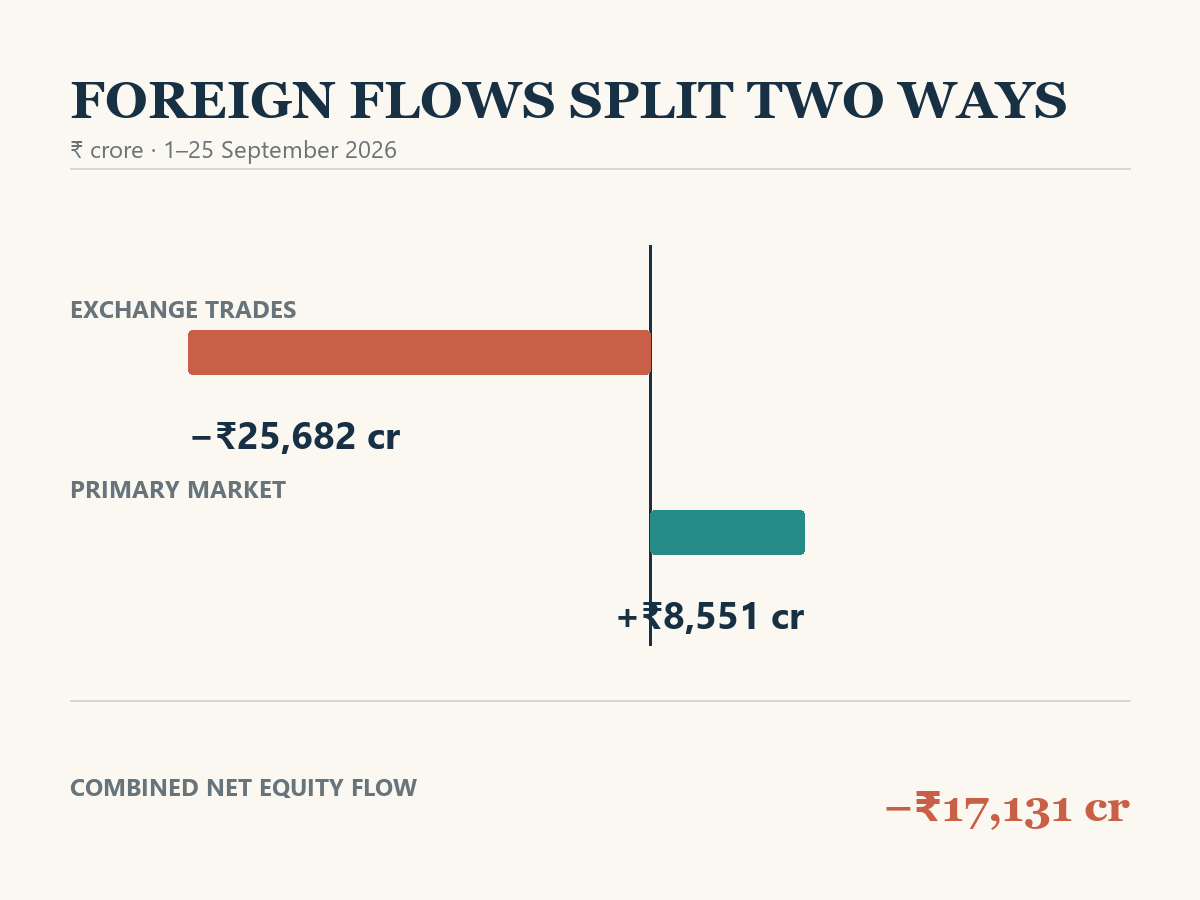
Exchange selling coexisted with primary-market buying. Source: Mint, reporting NSDL data.
This is a meaningful net outflow. It is not evidence that all foreign capital stopped. Foreign direct investment is a separate channel: NSE’s September compilation, citing RBI data, recorded net FDI of about $6.1 billion in April–June 2026. The period and measure differ, so it cannot be netted against September portfolio flows. NSE Market Pulse
Nor does every equity sale mean immediate repatriation. The seller may hold rupees or buy another Indian asset. Selling shares and removing capital from India are related possibilities, not identical events.
3. “DII confidence” is often someone else’s savings
DIIs include mutual funds, insurers and pension or provident institutions. Their purchases may reflect valuations, but also steady contributions, asset-allocation rules and benchmark mandates.
NSE recorded approximately ₹58,268 crore of net DII equity purchases in August 2026. AMFI recorded about ₹29,329 crore of net inflows into equity-oriented mutual-fund schemes in the same month. NSE Market Pulse, AMFI monthly report
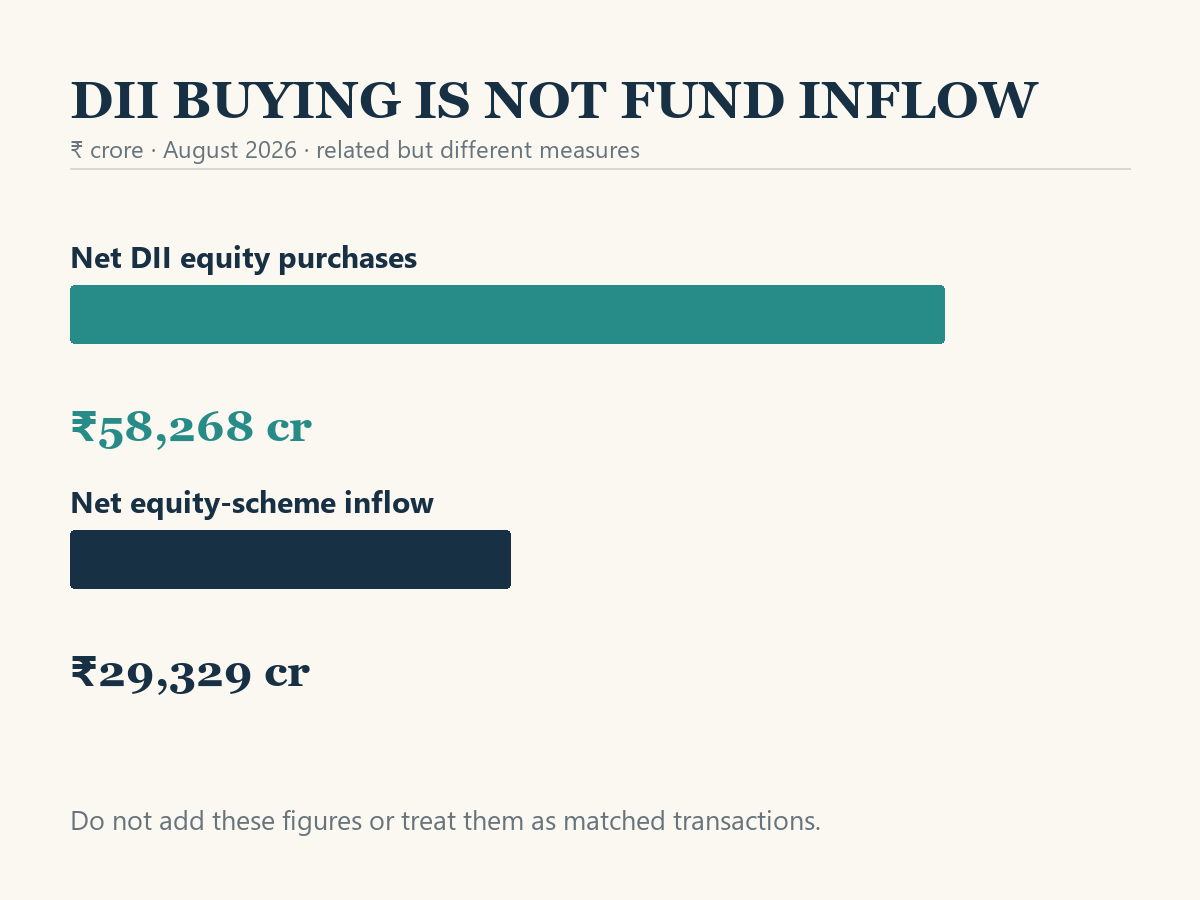
These are related but different measures. They must not be added or treated as matched transactions.
A mutual-fund investor owns units in a scheme. The AMC manages the portfolio; the scheme’s assets, liabilities and expenses determine its NAV. SEBI on mutual funds When an index fund receives money, its mandate is normally to track a benchmark, not repeatedly decide whether the whole market is cheap. SEBI on index funds
That makes the word “confidence” unreliable. Some DII purchases are active judgments. Others are the mechanical result of inflows and mandates.
Insurance is more varied. A unit-linked policy transmits investment performance into unit values; a traditional policy has contractual benefits and, where applicable, bonuses. A fall in an insurer’s equity portfolio does not create an equal percentage cut in every policy. LIC disclosures, LIC unit-linked product material
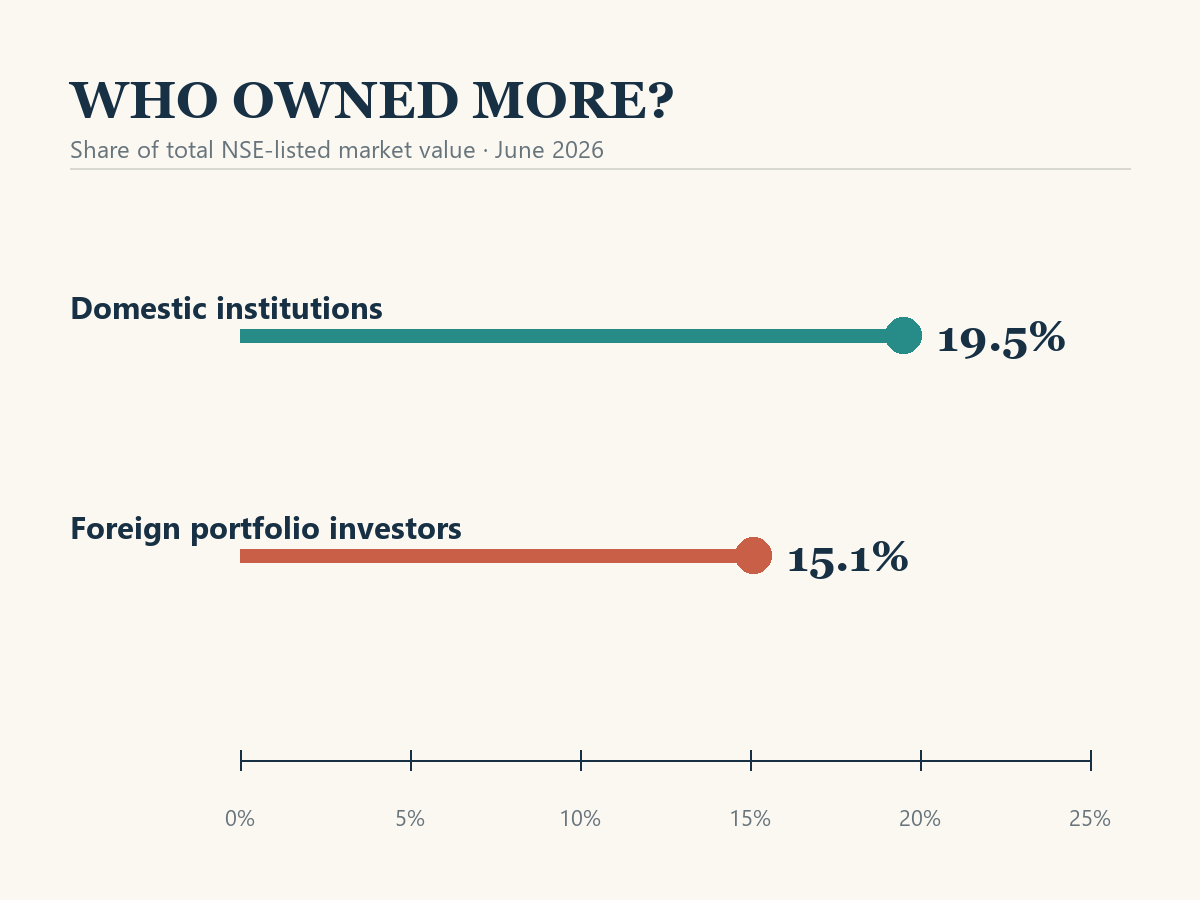
This is an ownership snapshot, not a complete breakdown or a measure of return. Source: NSE.
A larger domestic share can keep more dividends and future gains with Indian investors. It also keeps more losses with them. Assets under management measure the size of the savings industry. They do not measure the security of the saver.
4. Your SIP can finance a foreign investor’s exit
In a particular trade, yes.
If a domestic mutual fund buys ₹100 crore of existing shares from a foreign investor, the seller receives the cash and the fund receives the shares. The company receives no fresh money from that resale.
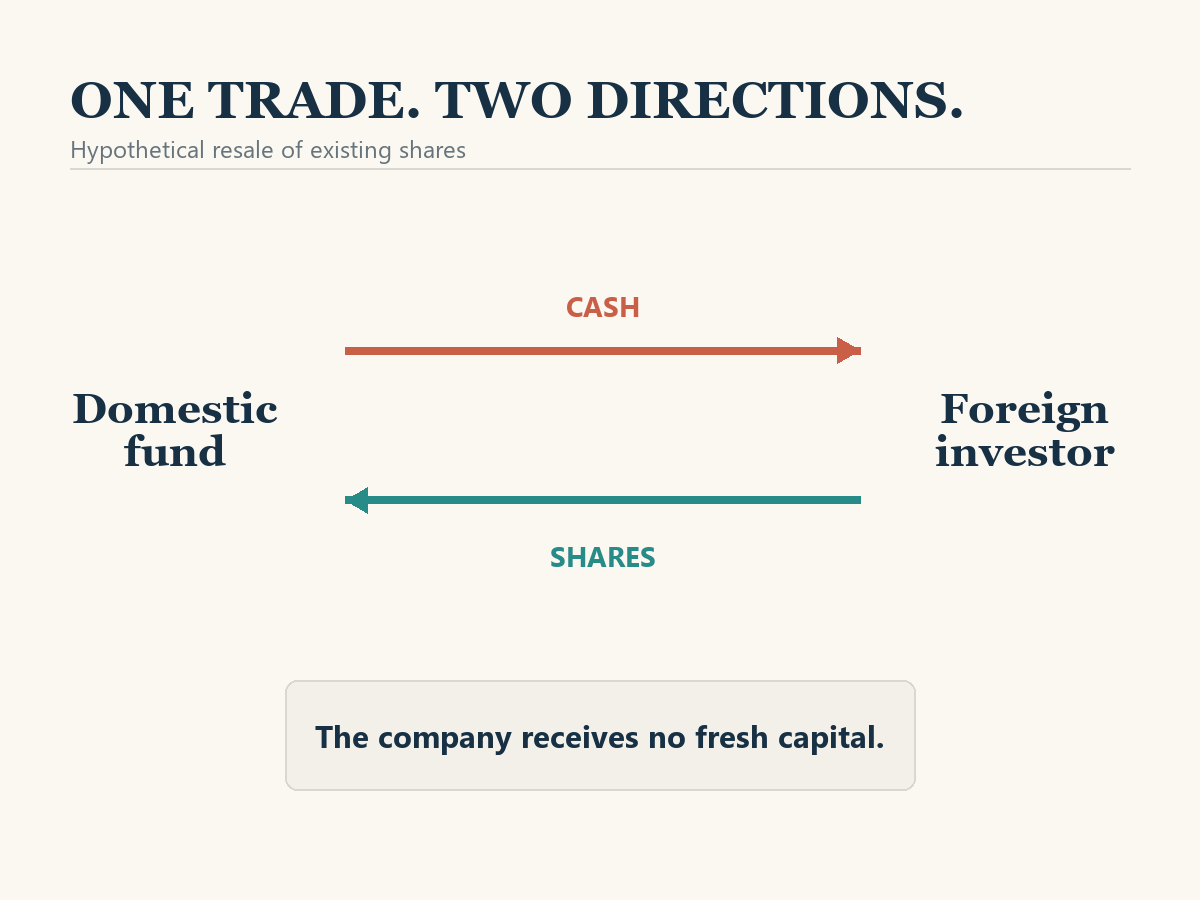
This illustrates one possible trade. Aggregate DII and FPI totals do not reveal matched counterparties.
The domestic fund is providing exit liquidity, but it is not giving away money. It receives an asset with future dividends, resale value and risk. The seller’s ₹100 crore proceeds are not necessarily profit; its gain or loss depends on what it originally paid.
Every completed trade has a buyer and seller. That accounting identity does not make long-term equity investing a zero-sum game. Companies can create profits and distribute cash. They can also destroy value.
The important question is not whether DIIs “absorbed” FII selling. They can. The question is whether savers acquired enough future earnings for the price paid.
The market-support argument is intellectually lazy. It answers who may buy today while avoiding whether the purchase is sensible. Liquidity and value are not the same thing. Research shows that institutional flows can affect prices when demand is not perfectly elastic; it does not prove that higher prices mean better value or that inflows will continue indefinitely. Gabaix and Koijen, 2021
“Someone had to buy what foreigners sold” is an explanation of market plumbing. It is not an investment case.
5. Buying an existing share does not build a new factory
Savings connect households, institutions and businesses, but the route matters.
A fresh issue sends the purchase money to the company. The company may use it for expansion, debt repayment, acquisitions or working capital. A secondary-market purchase sends the money to the previous owner. It changes ownership and establishes a market price.
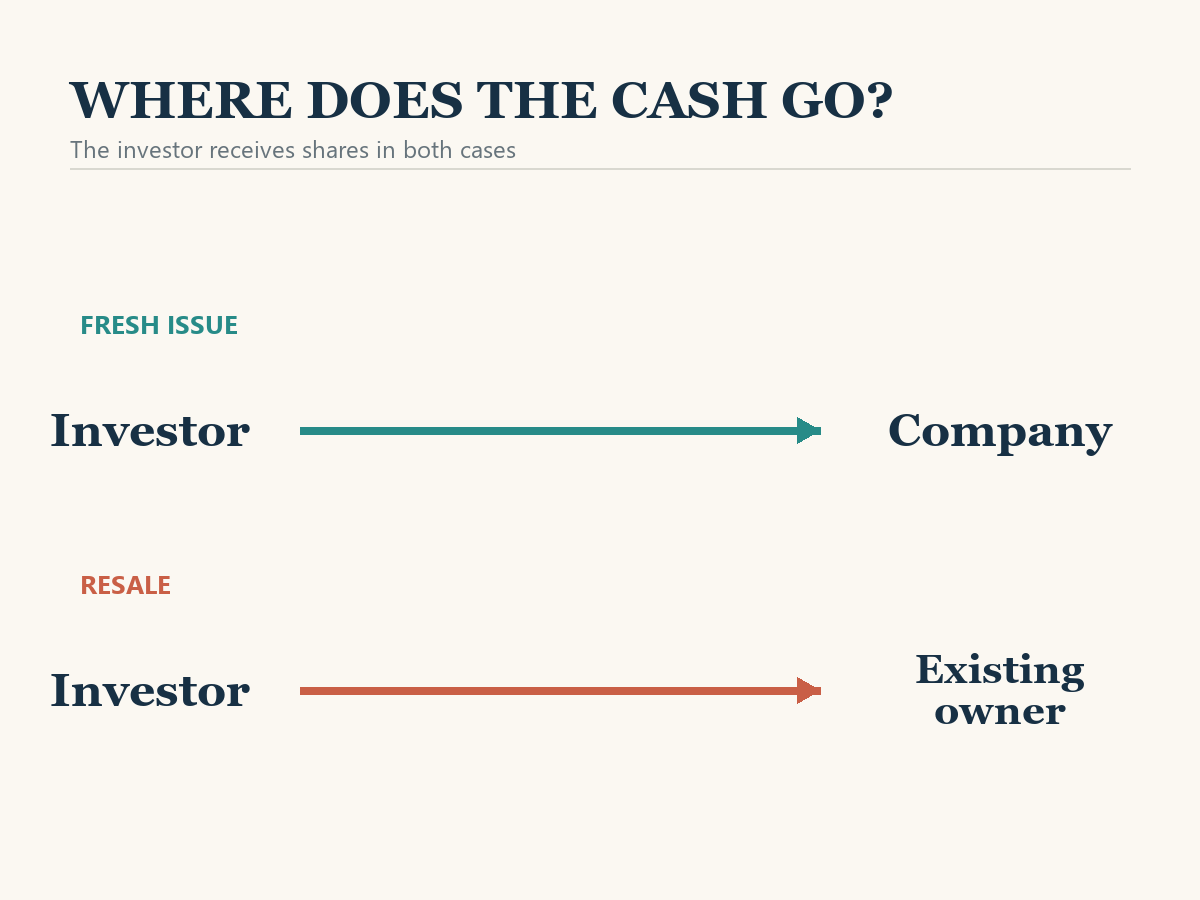
Both investors receive shares; this simplified diagram shows only where the purchase cash goes and omits fees.
An IPO can contain both newly issued shares and an offer for sale. The first raises capital for the business; the second pays existing shareholders.
Secondary markets still matter. Investors are more willing to fund businesses when they have a credible way to sell later, and price discovery influences the cost of future capital. But a rising market is not proof that companies received an equivalent amount of productive funding.
Claims that inflows are “funding India’s growth” should answer three questions: how much financed new activity, how much paid previous owners, and what companies did with fresh proceeds.
The wider cycle begins before the trade. Household spending becomes business revenue. Businesses pay employees and suppliers, invest and earn profits. Wages and distributions support another round of spending and saving. If living costs rise faster than incomes, households may cut both consumption and investment, weakening business demand and their ability to hold through a downturn.
Regular investing can encourage discipline. It cannot manufacture household resilience.
6. Judge the system by household outcomes
The relevant return is what money can eventually buy.
If an investment earns 8% while prices rise 5%, the exact real return is about 2.9%: 1.08 divided by 1.05, minus one.
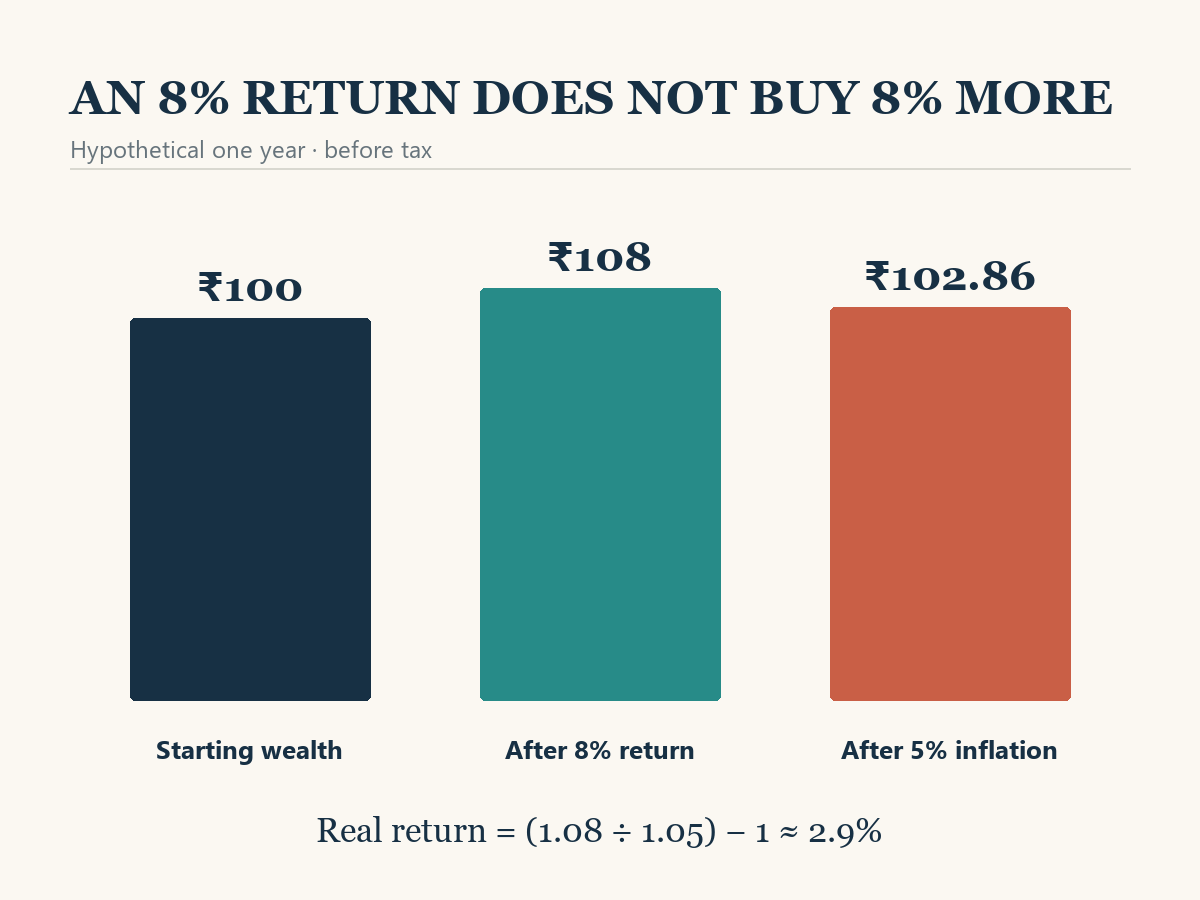
Hypothetical one-year rates before tax. A household’s personal cost increases may differ from headline inflation.
For a mutual-fund return reported through NAV, scheme expenses are already reflected; do not deduct them twice. Taxes and investor-level costs depend on the product and transaction. SEBI on NAV
Time matters too. A 20% fall requires a 25% gain merely to recover the starting value. A long horizon provides time; it does not guarantee recovery or help someone forced to sell early.
Investors should ask four questions:
- What do I own? Look through fund labels to companies, sectors and overlapping holdings.
- When will I need the money? Retirement in twenty years and fees next year cannot carry the same risk.
- What return can justify the price? GDP growth and DII buying do not establish a reasonable valuation.
- What remains after inflation, costs and tax? That is closer to the household outcome that matters.
Institutions deserve equally direct scrutiny. Active managers should explain returns after fees against appropriate benchmarks, portfolio concentration and valuation assumptions. Index managers should be judged on cost and tracking. Insurers and retirement funds should explain where investment risk ultimately sits.
My position is deliberately demanding: an industry entrusted with education funds, retirement savings and years of forgone consumption should not be applauded merely because household money kept an index steady.
India benefits when citizens own productive businesses and share in their success. That requires sensible prices, durable earnings and institutions worthy of their trust.
The index is an indicator. It is not the household’s financial goal.
Data and research notes
The figures retain their own observation windows: GDP and earnings cover April–June 2026; ownership is measured in June; market returns end on 31 August; mutual-fund and DII flows cover August; September foreign equity flows stop at 25 September. Ownership, flows, earnings growth and returns are different measures.
The valuation, currency, purchasing-power and drawdown examples are hypothetical. Diagrams explain mechanics and do not reconstruct aggregate trades. Charts were generated deterministically from the cited values and checked for labels, signs, scales and arithmetic.
Ritter’s historical cross-country findings are not a forecast for India. Gabaix and Koijen provide a framework for how flows may affect prices; their estimates are not applied mechanically to India. Earlier IMF research finds both domestic and external drivers of portfolio flows, but its historical sample cannot identify their weight today. Gordon and Gupta, IMF, 2003